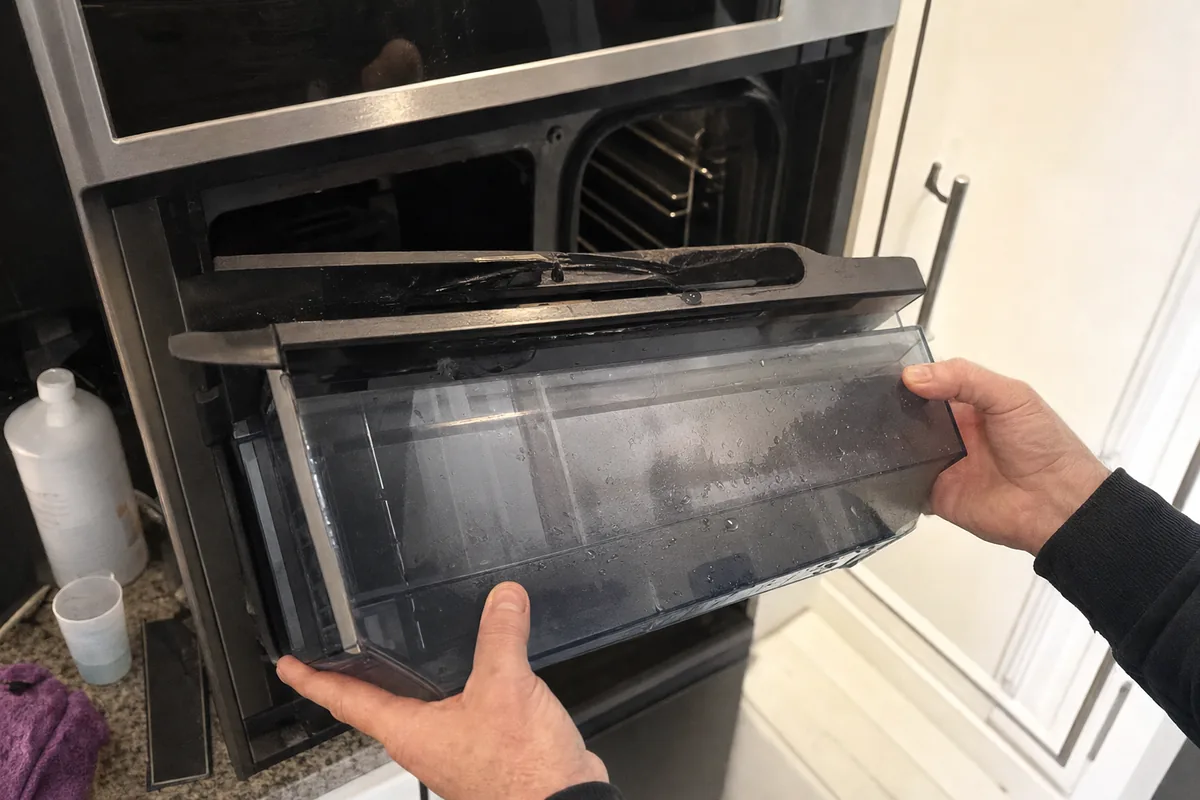
Every other appliance in a kitchen either does not use water or passes it through and out. A convection steam oven boils it. The water leaves as vapour and everything it was carrying stays behind, inside a small metal box, cycle after cycle for years.
That is the whole mechanism behind most steam-oven service calls, and it is why the symptoms arrive in a predictable order.
The three places deposit lands
On the heating surface. Deposit is an insulator. As it builds, the element has to run hotter to put the same energy into the water. Surface temperature climbs, the element ages faster, and steam production drops. Owners describe this long before any message appears: the steam seems weaker, or food comes out drier than it used to.
On the level-sensing hardware. This is the one that generates service calls, because a coated sensor does not read low — it reads wrong. The oven decides there is no water when the reservoir is full and puts up a message that sounds like a failed part. It usually is not. Replacing the sensor without cleaning the system puts you back in the same position within a year.
In the water passage. The line between the pump and the cavity has a small bore. Deposit narrows it, flow falls, and the cycle either runs long or never reaches the humidity it was aiming for.
Northeast Florida tap water is on the harder end of the range these appliances are designed around: JEA publishes 292 parts per million for 32250, about 17 grains per gallon. In practice that means the oven’s own descale prompt arrives sooner than the general guidance in the literature suggests, so treat the prompt as a deadline rather than a suggestion, and use the descaling product the manufacturer specifies.
Vinegar is not a substitute. The acid concentration is wrong, the rinse behaviour is wrong, and it can attack seals that a proper descaler leaves alone. Run the full rinse afterwards, every time — a cycle interrupted halfway leaves acid where you do not want it.
Reservoir or plumbed, and why it matters
Some installations fill from a reservoir you pull out and carry to the tap. Others are plumbed to the house supply, usually with filtration on the line.
The plumbed version is more convenient and it removes the one moment each week when somebody would otherwise notice a problem. Nobody handles the reservoir, so nobody sees the film on it, and an unchanged filter cartridge quietly stops doing anything. That cartridge is the single cheapest item on this page and the one most often overlooked; we check the supply, the shut-off and whatever filtration is on it on every plumbed steam-oven call.
The reservoir version has its own habits worth keeping. Empty it after use rather than leaving standing water in it, wipe the cavity floor while it is still warm, and look at the seal seat occasionally — a reservoir that seats on a distorted or dirty seal reports level faults that have nothing to do with the sensor.
What a visit checks, and in what order
Cheapest possibility first, every time.
- The supply. For a plumbed oven: the shut-off, the line and the filter. For a reservoir oven: the seat, the seal and the fill path.
- The report the appliance is giving. We run a cycle and watch how quickly the cavity fogs, how the control reports level, and whether the drain path clears. Behaviour under a real cycle tells us more than a static test.
- The cavity and the door. A gasket that has hardened or a door that no longer pulls square loses humidity continuously, and the oven compensates by running longer. That reads as weak steam and is not a water fault at all.
- The generator, pump and sensing hardware. Only after the first three, because each of them can produce the same complaint for a fraction of the cost.
When cleaning stops working
There is a point past which chemistry cannot recover the appliance. If an oven has gone several years untreated, the deposit can be thick and adherent enough that a normal cycle only lifts the top layer. If steam is still thin afterwards, if the level fault comes straight back, or if the cycle still runs long, the problem has moved from chemistry to hardware: a fouled generator, a restricted line, a tired pump, or a sensor that has been etched rather than coated.
That is a parts conversation, and it is worth having before you pay for a third cleaning cycle that will not work.
Getting one out of the wall
A built-in steam oven is heavier and more awkward than it looks, and on a plumbed installation it is also connected. Removal means isolating the circuit, closing and draining the supply, and lifting the appliance clear of an opening that is frequently a millimetre or two tighter than the specification allowed for. It is a two-person job with a clear path from the kitchen to somewhere flat to work.
Tell us when you book whether the oven is plumbed and whether anything has been built in around it since. It changes how long we hold the slot for, and it is the difference between finishing on the first visit and coming back.