Everything that goes wrong with cooking equipment on this island goes wrong on a schedule. Salt lands, absorbs moisture, sits, and does its work; grease loads a blower wheel a little at a time; scale builds cycle by cycle. None of it is sudden. All of it responds to intervals.
Here is the calendar we give people, with the reason attached to each item. Skip the reasons and the list is meaningless — the reason is what tells you whether your house needs a shorter interval than the next one.
Monthly
Wash the hood baffles properly. Not wipe — wash. They are designed to be dishwasher-safe. If you cannot see light through a baffle, it has stopped filtering and started restricting, and everything downstream of it is now collecting the grease that should have stopped there.
Wash and dry the stainless. Warm water, mild detergent, with the grain, rinse and dry. This is the step that prevents tea staining rather than treating it. In a house within a few blocks of the beach, monthly is the right frequency; if you keep sliders open most of the year, make it fortnightly.
Lift the burner caps and look at the port rings. You are looking for pitting, not dirt. A cap whose ports have lost their shape no longer meters air and gas correctly, and the flame tells you long before you notice the metal.
Rinse outdoor equipment with fresh water and dry it. Salt that gets rinsed off does nothing. Salt left through repeated wet-dry cycles pits.
Each season
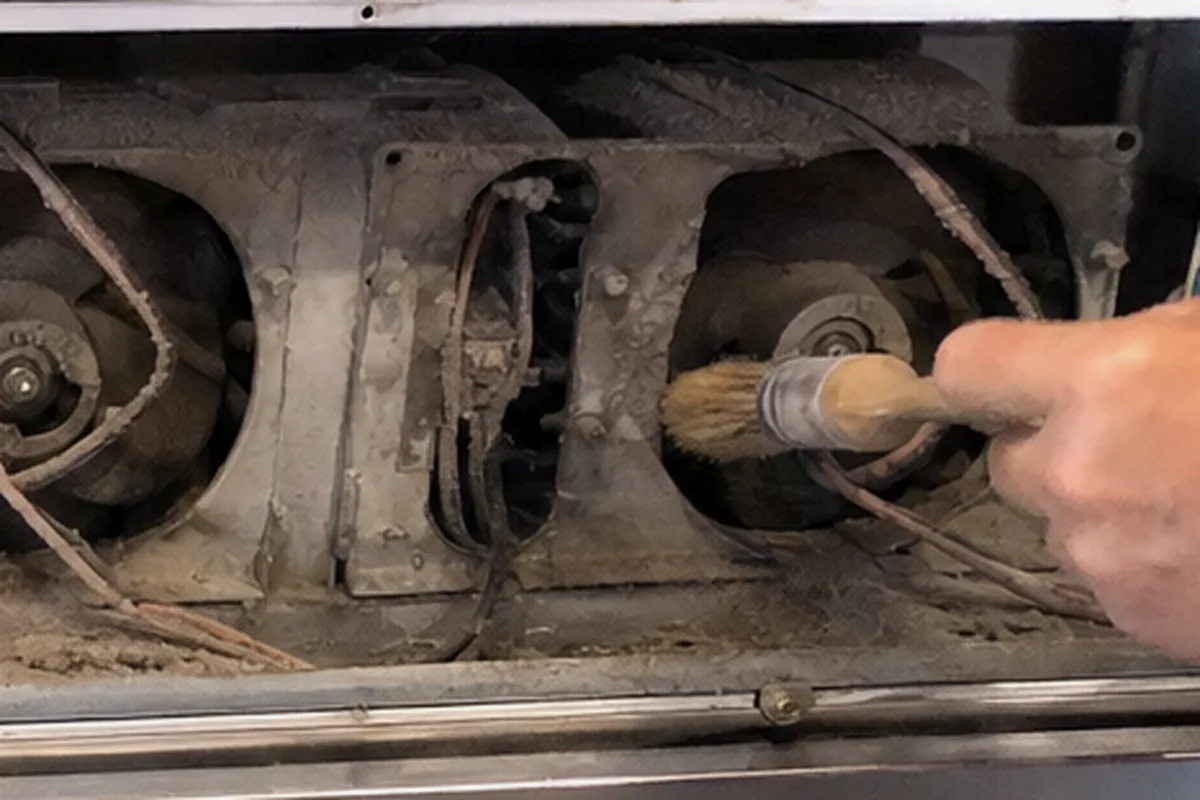
Look at the blower wheel with a torch. A visible ridge of deposit on the blades means the wheel is on its way to an imbalance. A wheel clean at this stage is a small job; a seized blower behind a corroded housing is not.
Check the hood’s wall or roof cap. Dampers corrode partly shut and screens clog with lint and salt crust. A perfect hood behind a throttled cap still fails to capture.
Work every control knob and valve through its full travel, including the ones you never use. Stems stiffen in salt air, and a valve that is exercised occasionally stays free far longer than one that sits.
Open and close the oven door slowly, watching the top corners. A hinge that has stiffened lets the door close a millimetre proud. That bleeds heat, the control compensates by running longer, and you get uneven browning that people blame on the recipe.
On an outdoor grill, pull the grates and heat diffusers, check the burner ports and the crossover path, and empty the drip tray. The tray perforates at its folded seam first because that is where water sits.
Once a year
Clean the steam oven’s water system whether or not it has asked, if a year has passed. The oven’s own prompt counts cycles and will normally beat the calendar, but the calendar catches the oven that is used lightly and fouls quietly.
Change the filter cartridge on any plumbed appliance. An unchanged filter is the most common single cause of faster-than-expected scaling we find.
Have the gas side checked. Manifold pressure, spark and ground at every electrode, burner and port condition. Ignition faults are the most common thing we are called out for here, and most of them are visible a season before they strand you.
Photograph the rating plates on everything and keep the photos somewhere you can find them. Model and serial numbers on the phone turn a guessing phone call into a specific one, and mean we arrive with the part rather than to look at it.
The one rule underneath all of it
Distance from the water sets the interval. A house on the numbered streets with the sliders open needs the shorter version of this list. A closed, conditioned house a few blocks west can run the longer one. Nobody on this island gets to run the inland version.